
VERIFIED X VISUAL PROMPT
HORROR MANGA — Inspired by Junji Ito
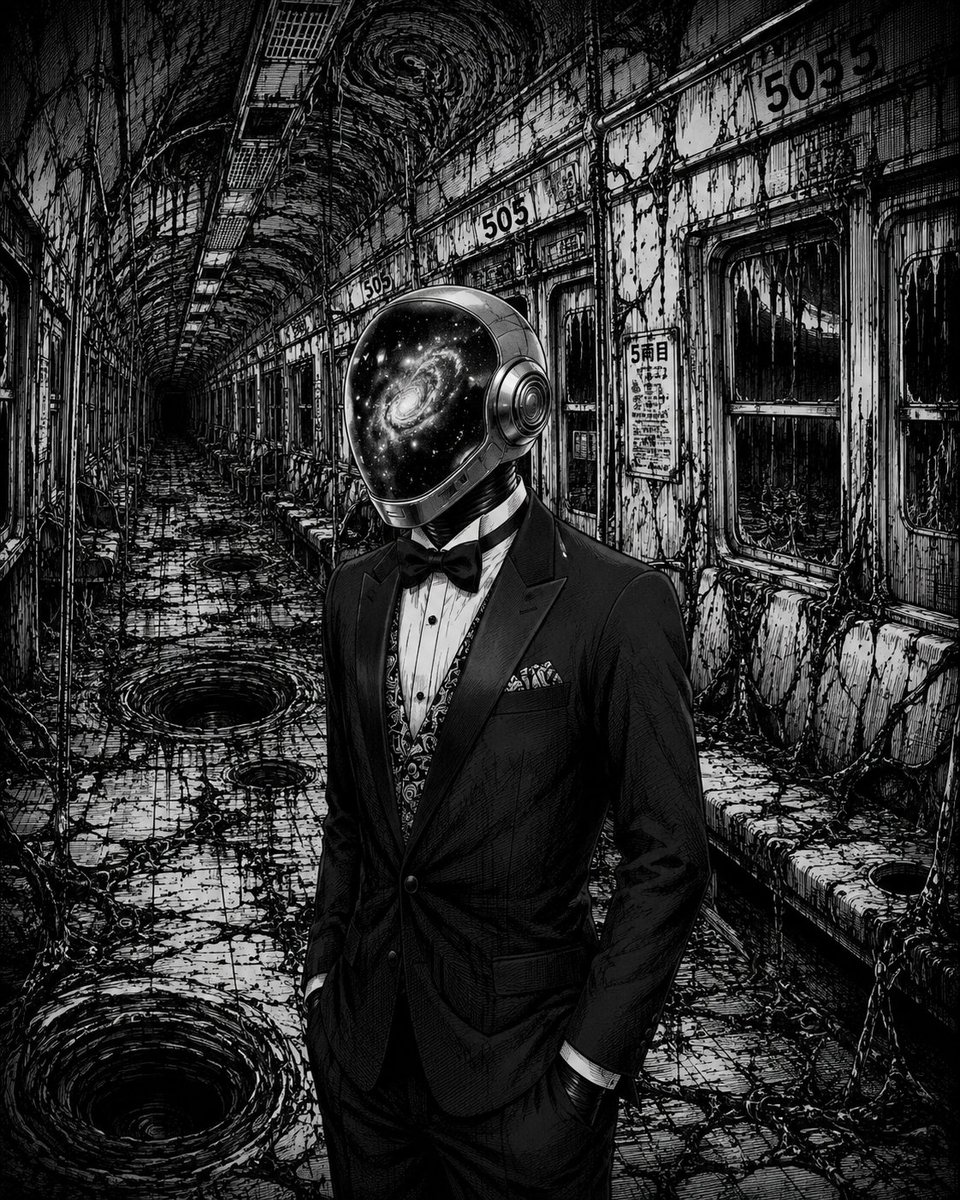
Creator: @ItsMidnightKei
Model: Not specified
用这个效果生成 View original X source ↗原始提示词
SOLO OC HORROR MANGA — UNIVERSAL PROMPT

Aspect Ratio: 4:5 Portrait

Use the supplied character reference as the absolute source of truth for the OC’s identity.

Create one polished black-and-white Japanese horror manga illustration placing the supplied OC alone inside a randomly selected horror scenario inspired by the surreal, psychological, environmental, cosmic, architectural, and body-horror concepts found throughout Junji Ito’s work.

Each generation should feel like a page from a different lost horror story starring this OC.

CHARACTER — IDENTITY LOCK

Preserve the OC’s recognizable:

face, age, skin tone, and facial structure

hairstyle, hair color, and silhouette
eyes and eye color
body type and proportions
gender presentation
species and anatomy
scars, markings, tattoos, prosthetics, horns, ears, wings, tail, or other defining traits
clothing and accessories
overall visual identity
Do not redesign, beautify, age, reshape, or otherwise alter the OC.

The character stays the same. The nightmare changes.

EXACTLY ONE CHARACTER

The supplied OC must appear exactly once.

There must be NO:

other people or background characters

humanoid monsters or ghosts

human-shaped silhouettes or shadows
bodies, heads, or faces
mannequins, dolls, or human statues
portraits or photographs of people
faces hidden in objects, clouds, trees, walls, or architecture
reflections containing people
duplicate versions of the OC
The horror must come entirely from the setting and environmental phenomenon.
If the chosen horror concept normally involves another person or creature, reinterpret it through the environment instead.

ONE OC. NOTHING ELSE ALIVE.

RANDOM HORROR GENERATION

Silently randomize all of the following for every generation:

LOCATION: Choose a fitting location such as an apartment, house, hospital, school, tunnel, forest, mountain, beach, coastline, empty city, suburban street, train station, hotel, alley, cave, shrine, laboratory, library, theater, industrial site, village, ordinary room, or impossible landscape.

HORROR: Choose one strong phenomenon inspired by the variety of Junji Ito-style horror concepts: impossible architecture, obsessive patterns, unnatural holes, warped landscapes, strange growths, environmental contamination, impossible gravity, cosmic phenomena, repeating spaces, spatial loops, supernatural weather, distorted reflections, unnatural water, bizarre biological textures, moving structures, impossible tunnels, strange celestial objects, environmental transformation, or another original surreal nightmare.

Do not default to spirals, giant eyes, villages, rain, or the same horror repeatedly.

STAGE: Randomly choose early warning, discovery, escalation, revelation, or aftermath.

COMPOSITION: Randomly choose close-up, waist-up, knees-up, full-body, environmental wide shot, low angle, high angle, profile, over-the-shoulder, walking toward/away from camera, looking backward, crouching, investigating something, entering somewhere, or confronting an enormous environmental phenomenon.

CHARACTER IN THE STORY

The OC must feel physically involved in the scene rather than posed in front of a background.

They may be walking, investigating, observing, touching something strange, entering somewhere, looking upward, examining a structure, cautiously moving forward, or reacting to an impossible discovery.

Match their reaction to their established personality.

Do not automatically make them terrified or screaming. Suspicion, fascination, unease, curiosity, determination, confusion, or eerie calm may be more appropriate.

ENVIRONMENTAL HORROR

The environment itself is the antagonist.

Possible disturbing details include:

impossible doors, windows, or stairways

roads looping back into themselves

water flowing uphill

rain stopping at invisible boundaries

repeating architecture

impossible shadows cast only by objects
unnatural cracks or patterns
strange organic growth
warped perspective
buildings bending unnaturally
structures appearing where they cannot physically fit
reflections showing impossible architecture
identical clocks or repeating numbers
tunnels or corridors with impossible depth
unsettling warning signs or scratched messages
Choose only details appropriate to the generated story.
The viewer should gradually realize:
Something is fundamentally wrong with this place.
No visible monster is necessary.
SCALE & 4:5 COMPOSITION

Create the image specifically for a 4:5 portrait canvas.

Use the vertical space intentionally.

Keep the OC near the primary visual center while allowing enough surrounding environment to establish the horror.

The character should generally occupy enough of the frame for their face, identity, clothing, and body proportions to remain clearly readable.

Do not make the OC unnecessarily tiny to showcase the environment.

All architecture and environmental objects must maintain believable scale relative to the OC:

doors

windows

buildings

furniture

streets

stairs

railings
trees
utility poles
tunnels
Use foreground, midground, and background depth so the OC appears physically inside the world rather than pasted over it.
VISUAL STYLE
Render as highly detailed black-and-white horror manga with:
intricate pen-and-ink linework
dense cross-hatching
stippling

scratchy shadows

dramatic blacks

stark highlights

detailed architecture

disturbing organic textures
atmospheric fog or weather when appropriate
oppressive negative space
realistic manga anatomy
unsettling perspective
extreme environmental detail
It should look drawn as horror manga, not like ordinary anime converted to grayscale.
OPTIONAL SELECTIVE COLOR
Keep the environment monochrome.
If the OC has one particularly important signature color, preserve it as a single restrained accent when appropriate—for example, colored eyes against an otherwise black-and-white image.
CLOTHING REFERENCE
If a separate outfit reference is supplied:
Character Reference = identity authority.
Outfit Reference = clothing authority only.

Transfer the outfit onto the OC while preserving their original face, hair, body, proportions, anatomy, species traits, markings, and identity.

Never transfer the clothing model’s physical identity.

RANDOMIZATION PRIORITY

Every generation should substantially change the:

location + horror phenomenon + stage + composition + environmental details.

Do not establish a default setting.

One generation might feature an apartment whose hallways repeat infinitely.

Another might place the OC beneath an impossible celestial phenomenon.
Another might feature a deserted train station whose tracks climb vertically into darkness.

Another might show an ordinary bedroom whose geometry has begun folding inward.

Another might place them beside a coastline where the ocean behaves impossibly.

Another might contain almost nothing overtly supernatural until the viewer notices one impossible architectural detail.

FINAL RULES

4:5 PORTRAIT.

EXACTLY ONE OC.

NO OTHER LIVING OR HUMAN-LIKE FIGURES.

NO DUPLICATE OC.

NO PEOPLE IN REFLECTIONS.

NO HUMAN FACES HIDDEN IN THE ENVIRONMENT.

NO DEFAULT SPIRAL/VILLAGE COMPOSITION.

PRESERVE THE PROVIDED CHARACTER’S IDENTITY.

Create the feeling that this OC has become the sole protagonist of a randomly selected, deeply unsettling Japanese horror manga story.

The character remains themselves.

Everything wrong comes from the world around them.