
VERIFIED X VISUAL PROMPT
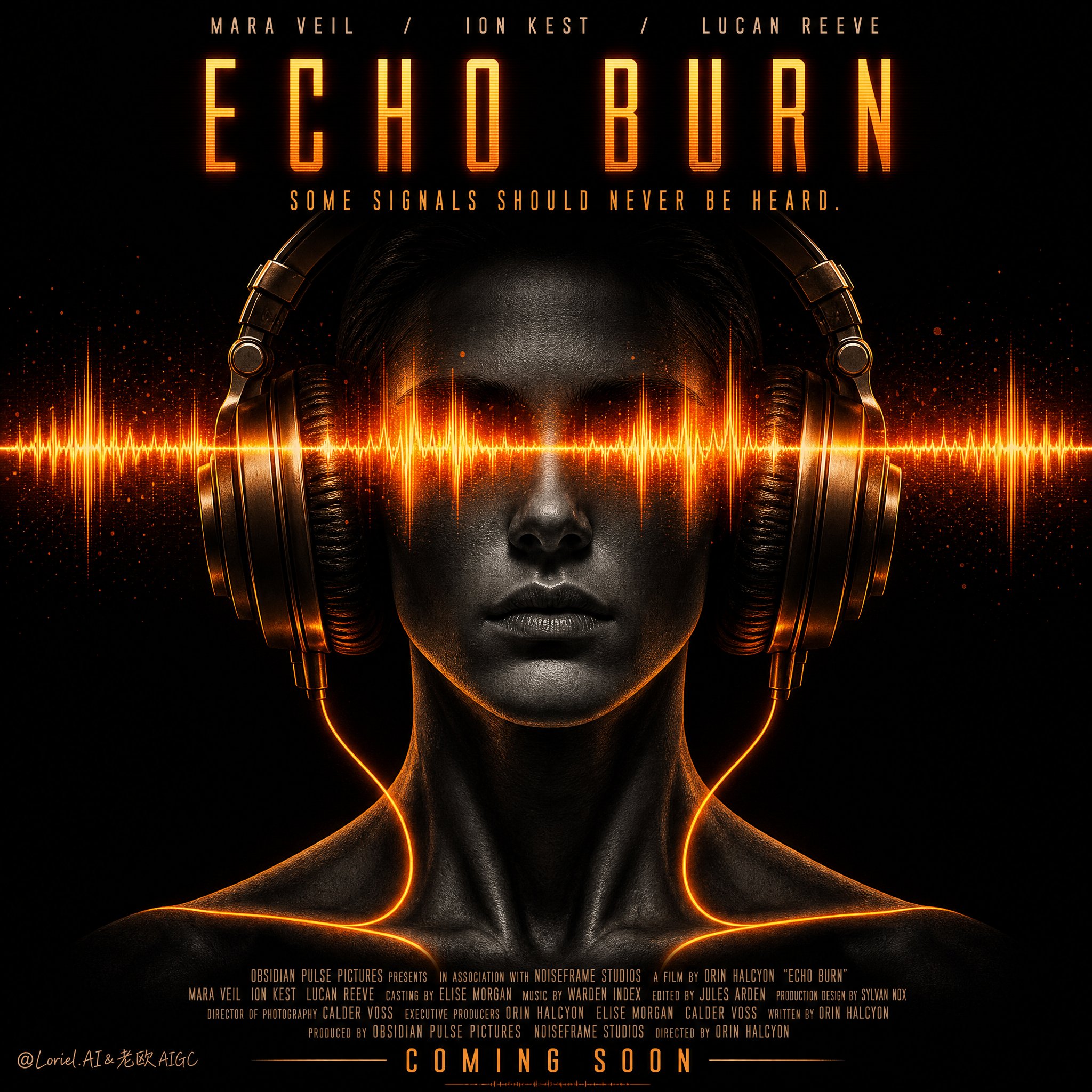
The poster works because the sound is turned i
Creator: @ou_zhen599
Model: Not specified
用这个效果生成 View original X source ↗原始提示词
Create a cinematic sci-fi thriller poster built around one fixed iconic visual system: a centered human bust, oversized symmetrical headphones enclosing the head, and a blazing orange waveform cutting horizontally across the eye line like a controlled signal visor. Use premium theatrical poster design with ultra-clean black negative space, strong neon contrast, and integrated typography.

Core composition:
vertical movie-poster layout, exact front-facing centered bust from upper chest to top head, shoulders tapering symmetrically downward, head aligned precisely on the vertical axis. Large over-ear headphones frame the head from both sides with near-perfect left-right balance. A bright orange waveform slices straight across the eye region from one side of the frame to the other, becoming the main visual band. Thin glowing orange cable lines descend from both earcups, pass along the neck contour, and continue across the upper chest as a subtle illuminated path. Keep the background almost pure black with only faint distressed particles around the signal band.

Port logic:
turn this exact arrangement into the unmistakable super-symbol of the franchise. The permanent identity must be built from four fixed codes: one centered grayscale human bust, one pair of symmetrical oversized headphones, one horizontal neon waveform masking the eyes, and one black field activated only by orange light. The result must feel instantly ownable, repeatable, and scalable across sequels and campaign extensions by changing only the waveform pattern, subtitle, and headphone design details.

Orbit logic:
build a strong closed visual loop through the poster. The eye should move from the main title at the top into the brightest waveform peaks, travel down the bridge of the nose to the lips and chin, continue along the glowing neck cables across the collar line, descend into the lower credit block, then return upward through the dark body silhouette and earcup edges back into the waveform band. The title spacing, waveform peaks, facial midline, cable contour, and credit block must all reinforce one continuous circulation path.

Subject design:
use one androgynous adult human bust with realistic anatomy, centered lips, straight nose, smooth jaw contour, visible neck tendons, and physically coherent shoulders. The expression must feel calm, controlled, and emotionally unreadable. Skin should be rendered in dark grayscale with visible pores, fine tonal transitions, soft specular highlights, and no plastic smoothing. Hair detail should remain mostly swallowed by darkness, reading as a clean dark head silhouette.

Headphone design:
render large premium over-ear headphones with metallic bronze-black shells, smooth industrial curves, satin-black structure, reflective edge highlights, padded earcups, and refined hinge geometry. The headphones must feel manufactured and tactile, not abstract. Their silhouette should frame the head symmetrically and catch controlled orange spill from the waveform.

Waveform design:
the orange audio waveform is the main graphic event. It must run horizontally through the eye zone with alternating large and small peaks, a hot yellow-orange inner core, and a softer orange bloom halo. The waveform should partially obscure the eyes while clearly reading as a signal graph. Add a restrained amount of particle scatter and digital dust around the waveform only.

Lighting:
near-total black environment with selective neon illumination. Main light source is the waveform and headphone edge spill, casting controlled orange highlights onto the nose bridge, upper cheeks, lips, chin contour, collarbones, and upper chest. Add extremely soft neutral grayscale fill from front to preserve facial structure. Contrast should remain high, with deep blacks but readable planes and no dead black patches.

Color system:
dominant black and charcoal grayscale for face and body, bright orange and amber neon for waveform and cable contours, restrained bronze highlights on the headphones. No extra colors. Maintain strict color discipline so the signal reads as the single active chromatic element.

Typography structure:
retain typography as an essential compositional layer, not decorative clutter. Use original English text only.
Top small cast line:
MARA VEIL / ION KEST / LUCAN REEVE
Main title centered near top:
ECHO BURN
Tagline beneath title:
SOME SIGNALS SHOULD NEVER BE HEARD.
Bottom area:
dense small legal-style credit block
one centered line:
COMING SOON
Typography must feel narrow, theatrical, spaced, and integrated into the black zones without colliding with the face.

Materials and texture:
skin with semi-matte grayscale finish and visible pore structure, headphones with brushed metal and satin polymer surfaces, waveform with emissive neon core and realistic bloom, background with black depth and faint micro-speckle around the signal area only. All materials must obey real light logic.

Symmetry and spatial design:
the composition should be almost symmetrical left-to-right, with minor waveform asymmetry creating tension. The face occupies the middle 50% of the frame height, title zone above, credit zone below. Headphones and waveform must remain instantly legible at thumbnail scale.

Image quality and physical constraints:
high-resolution theatrical poster sharpness, clean facial anatomy, no broken jaw, no distorted ears, no melted headphones, no unreadable waveform, no muddy shadows, no black blotches, no excessive smoke, no extra props, no text collisions with the face, no copied title, no watermark.

Negative prompt:
cartoon sci-fi, low-detail CGI, messy neon, random holograms, cluttered background, broken anatomy, asymmetrical face distortion, melted headphones, weak waveform, unreadable title, muddy shadows, dead black blocks, extra cables, random symbols, copied movie title, watermark, low resolution.