
VERIFIED X VISUAL PROMPT
The image works because the insect is not just
Creator: @ou_zhen599
Model: Not specified
用这个效果生成 View original X source ↗原始提示词
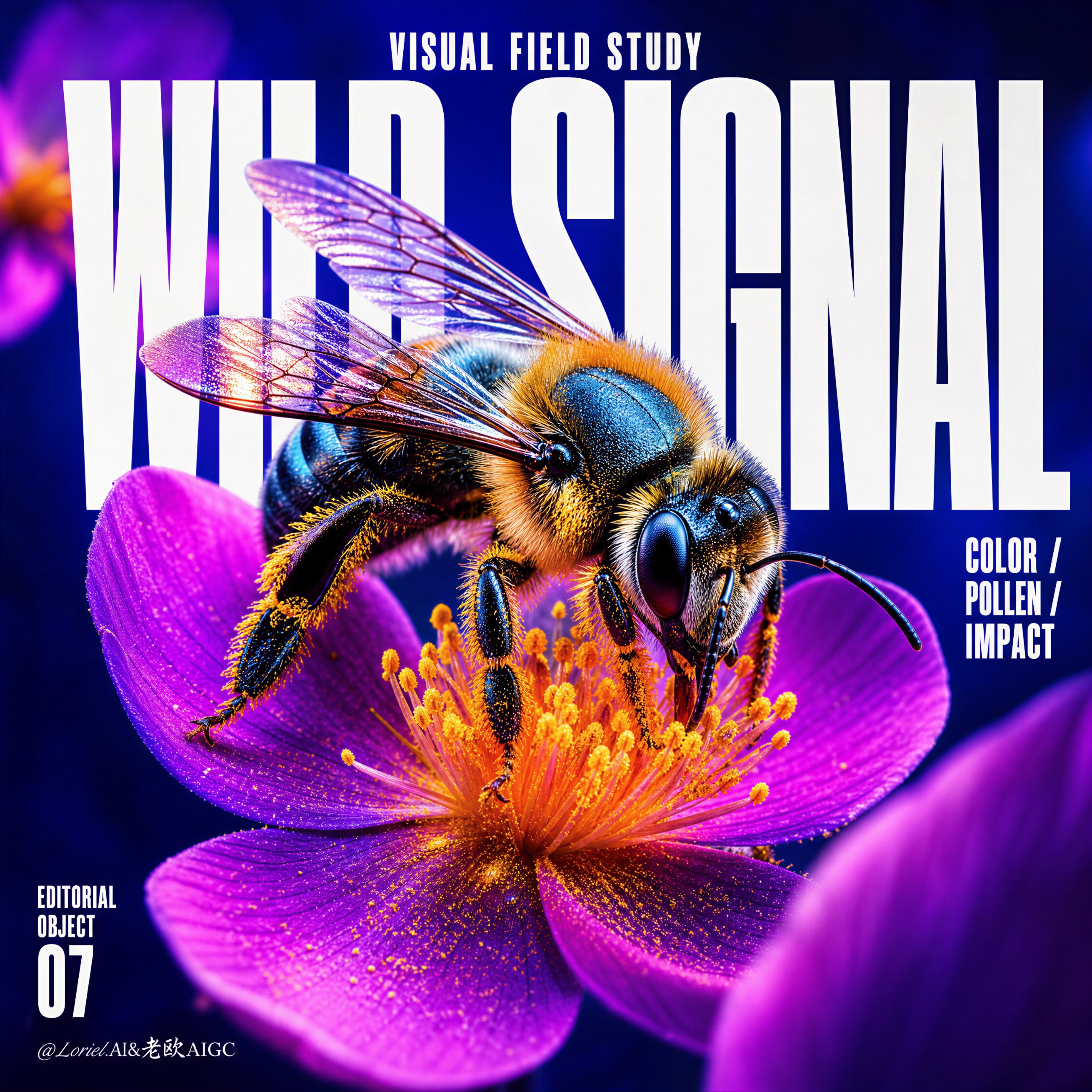
Create an ultra-detailed macro poster built around one fixed iconic visual system: a neon-lit pollinating insect suspended over a saturated flower core, a giant white condensed title embedded behind the subject, and a deep cobalt-to-ultraviolet background with soft floral bokeh. Use premium commercial macro-photography aesthetics with extreme micro-texture detail, controlled high saturation, and sharp editorial poster hierarchy.

Core composition:
vertical poster layout, one bee-like pollinator positioned slightly above the flower center, body angled diagonally from upper-left toward lower-right, legs gripping the stamens, wings partially open. A large five-petal magenta-violet flower occupies the lower-middle and central frame. One oversized blurred petal mass enters from the lower-right foreground, and one soft out-of-focus bloom enters from the upper-left background. The insect and flower core remain the sharp focal zone. Place one huge condensed white uppercase headline across the upper-middle to center background, partially obscured by the insect and flower, functioning as a structural design block.

Port logic:
turn this composition into the unmistakable super-symbol of the poster series. The permanent identity must be built from four fixed codes: one hyper-detailed pollinating insect, one glowing central flower core, one giant white title block behind the subject, and one deep blue-violet macro background with soft floral blur. The image should feel instantly ownable, repeatable, and scalable across a full visual series by changing only the insect species and flower type.

Orbit logic:
build a strong closed visual loop across the poster. The eye should move from the giant white headline into the insect head and antennae, travel across the luminous thorax fur and front legs, drop into the pollen-rich flower center, sweep across the lower petals and foreground blur, then rise back through the insect wing and body contour into the title block again. The antennae, leg placement, pollen dust, stamen direction, wing angle, and petal framing must all reinforce one continuous circulation path.

Typography structure:
retain text as a compositional object, not as editorial article text. Use original wording only.
Main title:
WILD SIGNAL
Top small line:
VISUAL FIELD STUDY
Side micro lines:
COLOR / POLLEN / IMPACT
Bottom-left small block:
EDITORIAL OBJECT 07
All text must feel bold, white, condensed, and integrated behind the subject.

Subject design:
use a bee-like pollinator with dense visible thorax fur, segmented abdomen, iridescent cyan-blue and warm amber transitions across the body, translucent pink-lilac wings, articulated legs coated with pollen grains, sharply defined antennae, glossy compound eyes, and visible mouthparts contacting the flower center. The anatomy must remain biologically coherent and physically believable.

Flower design:
use one five-petal blossom in saturated pink-violet with a dense central stamen cluster in hot orange-yellow. Petal surfaces should show powdery pollen dust, subtle translucency at thinner edges, fine veining, and tiny reflective particles. The flower must visually anchor the lower half of the poster.

Lighting:
soft but directional macro lighting from upper-left front, with strong chromatic separation. Main highlights should strike the insect thorax, eye edge, antennae, wing membrane, and upper petals. Add a secondary cool fill from the right to preserve blue-violet shadow information. Maintain readable shadows, high luminous contrast, and no crushed blacks.

Color system:
dominant deep electric blue and ultraviolet background, saturated magenta-violet petals, hot yellow-orange pollen, cyan-blue reflective accents on the insect, and pure white typography. Maintain strong warm-cool separation and high saturation without muddy blending.

Materials and texture:
extreme macro detail on insect fur, pollen grains, wing veins, petal dust, flower filaments, and micro-reflections. Preserve realistic subsurface scattering in petals, translucent wing physics, and granular pollen buildup on legs and flower center. Everything must obey real optical macro-photography behavior.

Depth of field:
very shallow macro depth of field. The insect head, thorax, front legs, and central stamens must be critically sharp. Foreground petals, background petals, and outer wing edges should soften progressively with premium optical falloff.

Style and rendering:
hyper-real macro photography fused with bold editorial poster graphics, neon botanical design language, premium poster finish, no flat illustration, no cartoon simplification, no low-detail CGI look. Keep the image dense, sharp, luminous, and tightly controlled.

Background:
deep cobalt-blue to violet gradient with soft abstract bokeh bloom and diffused floral blur only. No landscape, no extra environment, no clutter.

Image quality and physical constraints:
8k poster clarity, razor-sharp focal subject, clean typography edges, realistic insect anatomy, realistic pollen behavior, no extra legs, no broken wings, no muddy shadows, no black blotches, no unreadable text mass, no duplicated petals, no random debris, no watermark.

Negative prompt:
cartoon insect, flat illustration, low-detail fur, broken legs, extra legs, fused limbs, distorted wings, muddy neon, dead black background, unreadable headline, cluttered composition, weak flower center, washed-out pollen, plastic petal texture, low resolution, watermark, copied wording.